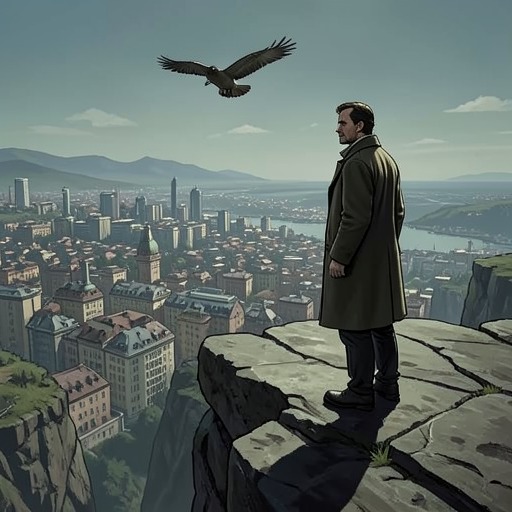
The great noontide
Thus Spoke ZarathustraThe great noontide is Zarathustra’s image for a decisive human threshold: humanity stands between its animal past and the possibility of the Superman, and must understand itself as a passage rather than a finished destination. Its noon is not a settled culmination. It is a moment of recognition and readiness, when the old grounds of value have given way and the future can be affirmed as a task. Across the book, the image binds together self-overcoming, the death of God, the promise of transformation, and the demand to affirm life without reserving an escape from it.
Meaning and Structure
The image makes a position in time into a measure of human existence. Humanity is at the middle of its course, between animal and Superman; it can celebrate the journey onward as its highest hope, because that journey leads toward a new morning. The metaphor therefore refuses to treat the human being as either a completed achievement or a final end. To stand at noon is to see both what humanity has come from and what it may yet become. The journey’s evening is not presented as mere decline: it is part of a passage that opens toward renewal.
This transitional meaning gives the image its characteristic doubleness. Noon suggests fullness and illumination, yet Zarathustra describes a humanity still going under in order to go over to the Superman. Its self-transcendence involves relinquishing the claim to be the measure of all things. At the same time, this overcoming is not framed as simple rejection of life: humanity is to bless itself in the very movement by which it passes beyond its present form. The sun of knowledge standing at noon marks an awakening to that change of scale and direction.
The great noontide is consequently both an anticipated hour and a standard by which to judge the present. It is repeatedly announced as near, but the announcements do not mean that transformation has already been completed. A bow must be drawn, an arrow made ready, and a star become ripe in its noon before the hoped-for victory can arrive. The language of ripeness and preparation gives the image a future-facing force: possibility is real, but it still demands formation, discipline, and endurance.
Humanity Between Animal and Superman
Zarathustra first places the teaching of the Superman before a crowd assembled in a town marketplace to watch a tightrope walker. He challenges his listeners to ask what they have done to overcome humanity, arguing that living creatures have produced something beyond themselves and that humanity must not reverse that movement by returning to the animals. The comparison sharpens the distance still to be travelled: just as the ape is a figure of embarrassment to humanity, humanity may appear so to the Superman. Human beings have come from earlier animal forms, yet retain what Zarathustra calls the worm within them; even the wisest remain discordant and hybrid rather than complete.
The marketplace speech supplies an evolutionary image, but the great noontide turns that image into an ethical and existential demand. The point is not simply that one form follows another. Humanity must take responsibility for its own passage, making its unfinished condition an object of hope instead of seeking comfort in preservation. Much later, Zarathustra puts the contrast directly to the Higher Men: the cautious ask how humanity can be preserved, while his question is how humanity can be overcome. After God has died, he says, the Higher Man can rise again and the mountain of humanity’s future can begin to labour. In this setting, the great noontide names the opening of a future that the loss of the old divine authority makes possible, not a return to the security that authority provided.
Announcement, Fire, and Preparation
The image recurs in Zarathustra’s prophecies as an approaching change in human scale. He foresees people becoming smaller, poorer, and more barren, and imagines that they may long for fire rather than water. Against this diminishing condition, he blesses the hour of lightning and the mystery before noon: one day, he says, those people will become running fire and heralds whose tongues announce that the great noontide is near. The contrast is between an impoverished present and a future in which those now diminished can carry a force of transformation. The prophecy makes the announcement itself part of the transition, though it does not claim that the promised change has already occurred.
A related image appears in the warning about the great city. Zarathustra wishes he could see the pillar of fire by which it would be consumed, since such pillars must precede the great noontide; nevertheless, the city has its own time and destiny. The fire is thus a sign of rupture before renewal, not a report of an accomplished event. Zarathustra’s farewell counsel to pass by where love is no longer possible gives that prophecy a practical edge: not every existing condition can be repaired or made fruitful. The approaching noon requires discernment about what to leave behind, as well as readiness for what may follow.
Preparation also has an inward form. Zarathustra addresses his will and asks to be preserved from petty victories, so that he may one day be ready and ripe for one great victory. He imagines himself as a bow eager for its arrow, the arrow eager for its star, and the star itself ripe in its noon. The sequence makes aspiration more than a wish for triumph: each figure is oriented toward a further end, and readiness depends on not mistaking lesser victories for completion. In another prophetic image, the one who would kindle the future must hang over the mountains like a heavy storm, pregnant with lightning that affirms and laughs. The great noontide gathers this charged waiting into a single image of imminent but unfinished transformation.
Affirmation and the Eternal Recurrence
The great noontide is linked to Zarathustra’s teaching of the Eternal recurrence, which tests whether life can be affirmed without qualification. In a song addressed to Zarathustra, the possibility of dying and decaying does not cancel the return: the same life, not a better or merely similar one, would recur. Zarathustra is named there as the teacher of recurrence and as the one who would speak again of the great noontide of earth and humanity and of the Superman. The juxtaposition connects the future-oriented hope of overcoming with an uncompromising affirmation of this life. What is to be overcome is not life itself, but the restricted form in which humanity has so far understood and valued it.
The later formulation of the recurrence makes that demand more exact through joy. To say yes to one joy is also to say yes to the woe chained and entwined with it; to want a moment a second time is to want everything to return. Joy, on this account, cannot be isolated from the conditions and consequences that compose a life. The great noontide’s promise of a new human future therefore does not depend on repudiating the world in favour of another one. It belongs to an affirmation that accepts the whole entanglement of existence, even as it seeks to create beyond the present human type.
An introductory account of the book places the Superman, the will to power, self-overcoming, dangerous living, Amor fati, recurrence, and total affirmation among the signs by which Friedrich Nietzsche surmounted nihilism and resolved his crisis. It also traces a Christian parallel: Lutheran Pietism’s acceptance of life as divinely willed is set beside Amor fati, while the extremity of recurrence is compared with the Christian idea of eternal life. The comparison offers an interpretive genealogy, not an identity between the doctrines. Within Zarathustra’s teaching, the decisive emphasis falls on affirming life and creating a future after the old religious guarantee has lost its force.
The Image’s Fulfilment and Its Limits
The great noontide also marks a transformation in Zarathustra’s relations with his disciples. He tells them to lose him and find themselves, and says he will return only after they have denied him. He imagines meeting them again with different eyes and a different love; once more they will be friends and children of one hope, and he will celebrate the great noontide with them a third time. The sequence makes separation part of his teaching rather than a repudiation of it. His followers must cease merely to depend on the teacher before they can share the hope as their own.
That promise remains open at the close of the book. When Zarathustra hears the Higher Man cry out in pity, his response turns from pity for that figure toward his own work. He declares himself ripe, says that the lion has come and his children are near, and announces that his day begins as he leaves the cave. The scene gives the great noontide the force of a threshold crossed: the period of inward readiness is ending, and Zarathustra is prepared to move out again. Yet the ending does not show the Superman’s arrival or humanity’s completed transformation. It offers signs of readiness and a new beginning, preserving the image’s central tension between a future ardently announced and a task still to be fulfilled.